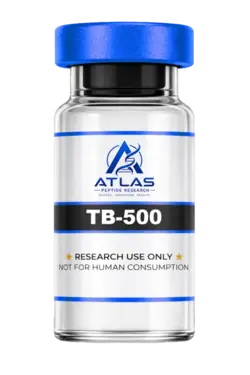
TB-500
Thymosin Beta-4 Fragment (Ac-SDKPDMAEIEKFDKSKLKKTETQEKNPLPSKETIEQEKQAGES)
At a Glance
Molecular Properties
Overview
Compound Description
TB-500 is a synthetic peptide corresponding to the full 43-amino-acid sequence of thymosin beta-4, a naturally occurring protein first isolated from the thymus gland. The active region, comprising the actin-binding domain LKKTETQ (residues 17-23), has been extensively studied for its role in actin dynamics, cell migration, and angiogenesis. Thymosin beta-4 is one of the most abundant intracellular peptides in mammalian tissues and has been investigated in over 100 preclinical and clinical studies.
Mechanism of Action
Research-Identified Pathways
The primary biochemical activity of thymosin beta-4 involves 1:1 binding of monomeric G-actin through the LKKTETQ sequence motif, which sequesters actin monomers and prevents spontaneous polymerization into F-actin filaments. This mechanism modulates cytoskeletal dynamics and is associated with enhanced cellular motility.
Research has demonstrated that thymosin beta-4 activates integrin-linked kinase (ILK), a serine-threonine kinase involved in cell survival signaling through the Akt/protein kinase B pathway. In endothelial cell models, this activation has been associated with enhanced tube formation and capillary outgrowth, suggesting involvement in angiogenic processes. Additional studies indicate that thymosin beta-4 may modulate inflammatory responses through regulation of NF-kB signaling and promotion of anti-inflammatory mediators in tissue microenvironments.
Key Research Findings
Published Study Highlights
- Research demonstrates 1:1 G-actin sequestration through the LKKTETQ binding domain, modulating cytoskeletal reorganization and cell migration
- Studies indicate activation of integrin-linked kinase (ILK) and downstream Akt survival signaling in cardiac cell models
- Preclinical corneal wound healing studies show accelerated re-epithelialization and reduced inflammatory markers
- Endothelial cell assays demonstrate enhanced tube formation, migration, and capillary outgrowth in angiogenesis models
Areas of Research Interest
Why Researchers Are Investigating This Compound
This compound has attracted significant research attention in the following areas. These represent active fields of scientific inquiry, not validated therapeutic claims. No medical benefits are stated or implied.
- Athletic recovery and injury repair: frequently discussed in sports science circles for its investigated role in muscle, tendon, and ligament healing pathways
- Cardiac tissue research: attracted significant attention after Nature published findings on its role in cardiac cell migration and survival signaling
- Anti-inflammatory applications: researchers are investigating its potential to modulate inflammatory responses in tissue injury models
- Hair follicle biology: preclinical studies examining its effects on hair follicle stem cell migration have generated considerable research interest
Published Research
Peer-Reviewed References
- Bock-Marquette I, Saxena A, White MD, DiMaio JM, Srivastava D "Thymosin beta4 activates integrin-linked kinase and promotes cardiac cell migration, survival and cardiac repair." Nature (2004). doi:10.1038/nature03000
- Goldstein AL, Hannappel E, Sosne G, Kleinman HK "Thymosin beta4: a multi-functional regenerative peptide. Basic properties and clinical applications." Expert Opinion on Biological Therapy (2012). doi:10.1517/14712598.2012.634793
- Sosne G, Szliter EA, Barrett R, Kernacki KA, Kleinman H, Hazlett LD "Thymosin beta 4 promotes corneal wound healing and decreases inflammation in vivo following alkali injury." Experimental Eye Research (2002). doi:10.1006/exer.2001.1125
- Maar K, Hetenyi R, Maar S, et al. "Thymosin Beta-4 and Derivatives as Regenerative Therapeutics: A Literature Review." Cells (2021). doi:10.3390/cells10061343
Research Use Only
The information presented on this page is compiled from peer-reviewed scientific literature and is provided solely for educational and research purposes. This compound is intended exclusively for laboratory and scientific research use. It is not a drug, pharmaceutical, or dietary supplement. It is not intended to diagnose, treat, cure, or prevent any disease or medical condition. No claims of therapeutic efficacy are made or implied.
Researchers are advised to consult the original published studies referenced above for complete methodological details, study limitations, and the authors' own conclusions. Atlas Peptide Research does not endorse any specific research application and provides this information as a reference resource only.
Interested in TB-500?
View this compound in our shop to see available sizes, certificates of analysis, and current pricing.
View in Shop